The hypnosis paradox: why some sharks will not play dead
There is a party trick that has haunted shark science for decades.
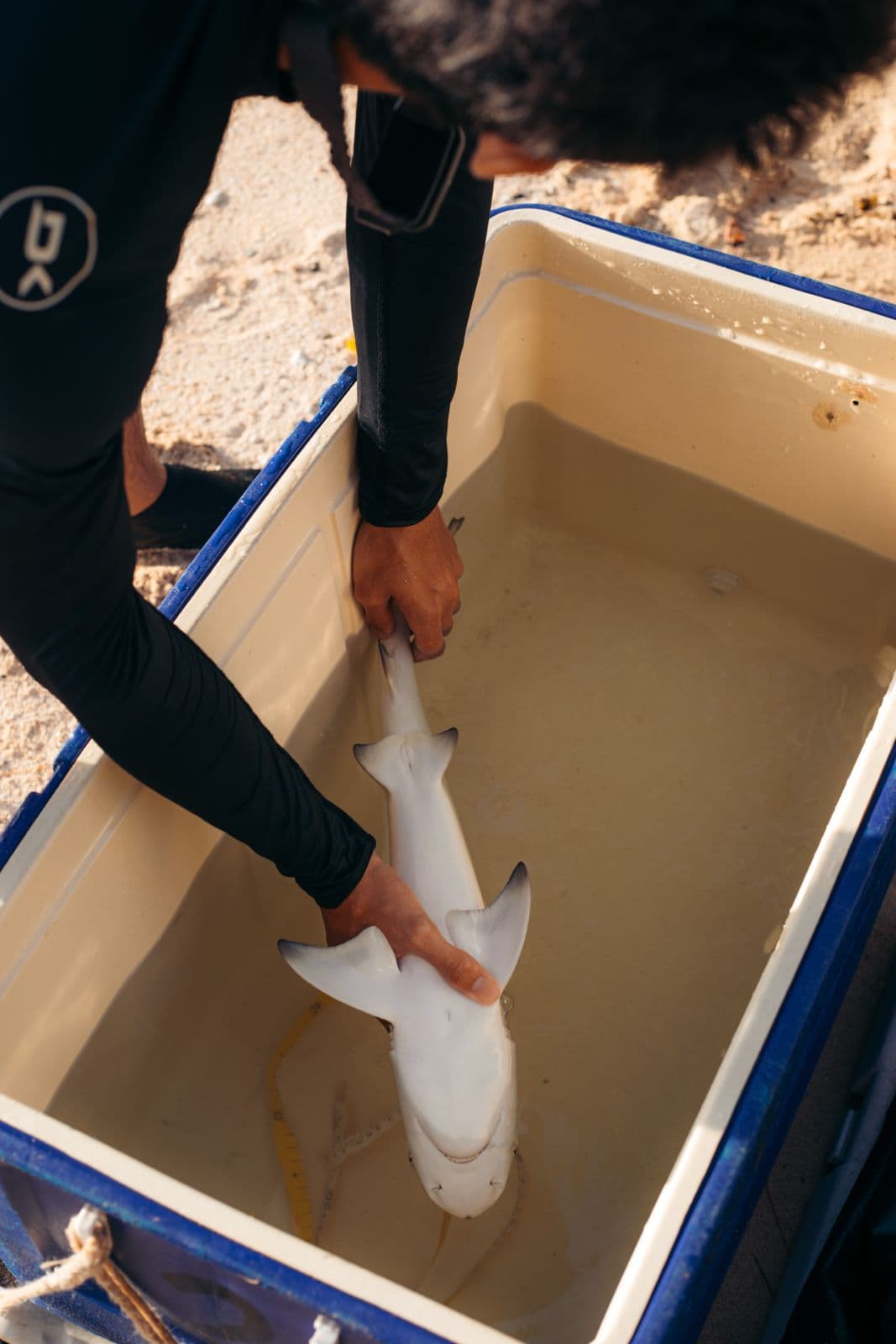
Flip a shark upside down and it goes limp. Eyes glaze over. Muscles relax. Breathing slows into a deep, rhythmic trance. Researchers have used it during surgery. Aquariums have used it for veterinary checks. The internet has turned it into "shark hypnosis."
But here is the problem. Why would an apex predator evolve an off switch that any creature with a thumb can activate?
In Episode 003 of Athletes of the Reef, we dive into a 2025 paper led by Joel H. Gayford and Jodie L. Rummer, published in Reviews in Fish Biology and Fisheries, that completely reframes tonic immobility in sharks. The conclusion is deliciously uncomfortable: this behaviour may not be an adaptation at all. It may be evolutionary baggage.
The old story: playing dead
For years, tonic immobility was explained as a form of thanatosis - "playing dead." Possums do it. Insects do it. Go limp and maybe the predator loses interest.
Except sharks do not go rigid. They go ragdoll. It is a Tonic Limp Response, not a freeze. Muscles relax. The animal appears calm. Some stress hormones even increase. That is not classic anti-predator behaviour.
And their predators - larger sharks and orcas - are not fooled. Orcas deliberately flip rays upside down to induce this state before eating them. If this is a defence mechanism, it is a spectacular design flaw.
Science does not like design flaws. So we tested the assumption.
Testing the myth across the shark family tree
Rather than asking why sharks do this, we asked a simpler question: do all sharks actually do it?
Across lab and field trials, and with input from global collaborators, we assembled data from 13 species. Nearly half did not exhibit tonic immobility at all.
Most striking was the first empirical test on a chimaera - the so-called "ghost shark" (Callorhinchus milii). Chimaeras are the sister lineage to sharks and rays, splitting off hundreds of millions of years ago. If tonic immobility were a deeply conserved trait, we would expect to see it there.
We did not.
Four individuals were tested. None went limp. They righted themselves immediately.
The epaulette shark - the oxygen-tolerant reef athlete many of you know well - also refused to comply with the hypnosis narrative.
So what is going on?
When we mapped the behaviour onto the phylogenetic tree, a pattern emerged. Tonic immobility appears to be a plesiomorphy - an ancestral trait inherited from early jawed vertebrates.
In plain language: it is old code.
Not an app newly installed for a modern purpose. Old software still running in some lineages, quietly deleted in others.
The idea that it is a mating strategy also falls apart under scrutiny. If flipping a female induced paralysis, that would create enormous evolutionary vulnerability. Natural selection is not that sloppy.
Instead, what we are likely witnessing is trait loss.
Why reef sharks are "deleting the app"
Think about habitat.
An epaulette shark lives in shallow, structurally complex reef flats. Crevices. Coral heads. Surge channels. Now imagine being flipped upside down in that environment and instantly going limp. You could wedge into coral. Drift into hypoxic pockets. Fail to right yourself in time.
In a reef, going limp can be fatal.
In the open ocean, a brief inversion is unlikely to matter. There is less structural chaos. Less mechanical risk. So the selective pressure to remove the trait is weaker.
This is not about sharks being weak. It is about context. Evolution trims traits that impose costs. In dynamic reef systems, tonic immobility appears to be one of those costs.
Why this matters for shark research
Tonic immobility has been used as a handling tool - a mild, non-pharmacological "anesthetic" during tagging and sampling.
Our findings show that it does not work universally. More importantly, limp does not equal relaxed. A quiet shark may still be physiologically stressed.
If we care about ethical research and conservation, we need to respect species-specific physiology rather than assuming a trick applies across an entire clade.
Healthy sharks equal healthy reefs. But healthy science requires revisiting comfortable myths.
The bigger picture
The hypnosis paradox is not really about sharks falling asleep. It is about how easy it is to mistake persistence for purpose.
Just because a trait exists does not mean it is adaptive now. Evolution is a historian, not an engineer. It carries forward remnants, then deletes them when costs exceed benefits.
Episode 003 pulls apart one of the most viral shark behaviours and replaces spectacle with nuance. What looked like a secret weakness may instead be an evolutionary relic - a hangover from deep vertebrate history.
And if there is a lesson here beyond shark science, it is this: when something in biology feels too tidy, it probably deserves another look. Sometimes the most interesting discoveries come from asking the question everyone assumes has already been answered.