The Lost Manual: Why Policymakers Are Ignoring the Ocean's User Guide
Imagine buying a used car. You walk around the lot, check the paint, and kick the tires. It looks pristine. You sign the papers, drive it off the lot, and ten miles down the road, the engine explodes. Why? Because you only looked at the outside. You never checked the oil pressure, the temperature gauge, or the mechanics under the hood.
In the world of marine conservation, we are often making the exact same mistake. We draw boundaries on a map, designate them as "Marine Protected Areas," and assume the ecosystems inside are thriving simply because current population numbers—the ocean’s paint job—appear stable. But beneath the surface, the animals are running a fever, their blood chemistry is shifting, and they are gasping for air.
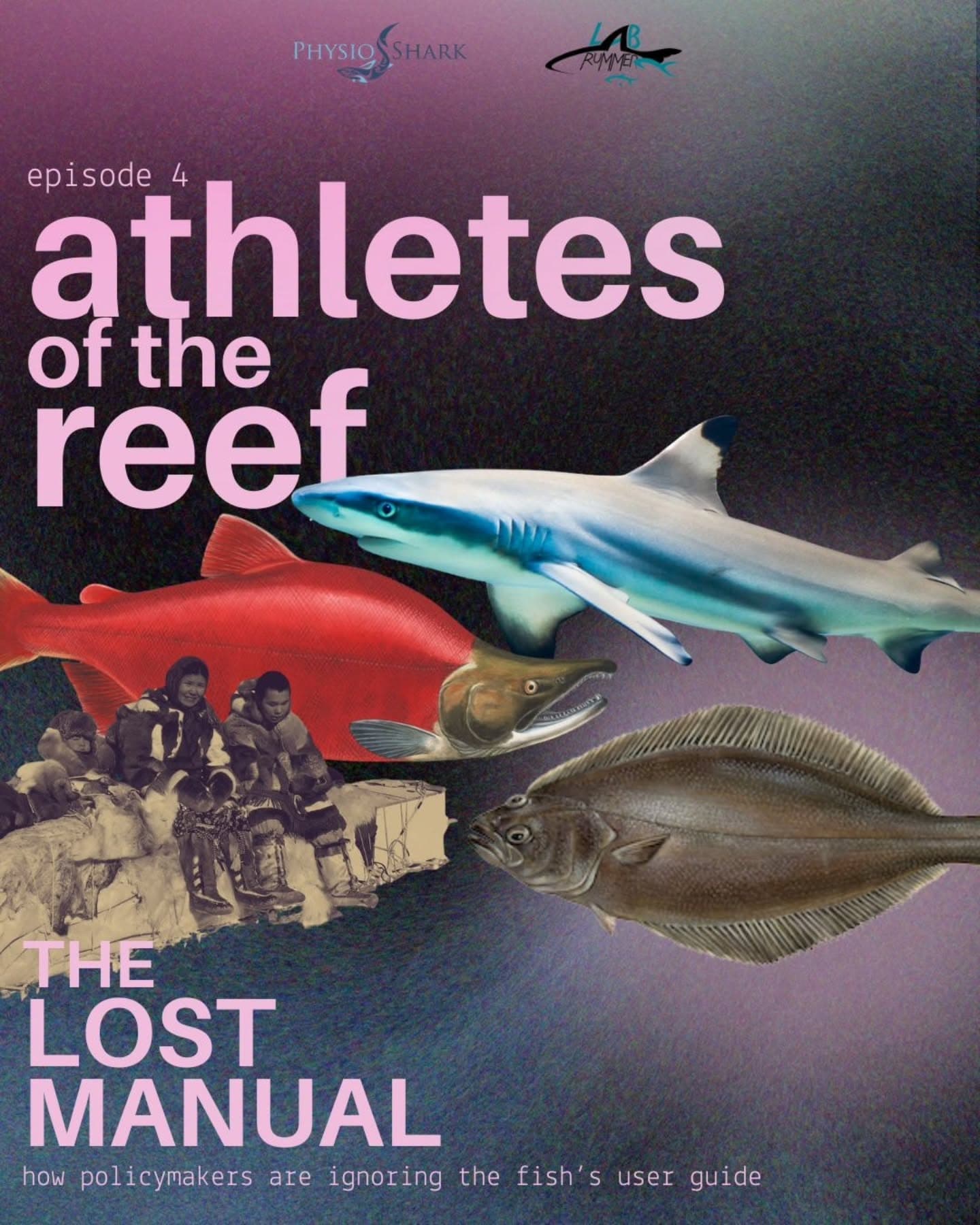
This systemic disconnect between biological reality and environmental policy was the focal point of Episode 4 of the Athletes of the Reef podcast, featuring Dr. Jodie Rummer. The discussion centered on a pivotal 2025 perspective paper published in the Journal of Experimental Biology titled, "Harnessing physiological research for smarter environmental policy." Led by Dr. Alexia Dubuc, alongside co-authors Courtney Burns, Shamil Debaere, and the team at RummerLab, the paper serves as an urgent call to action: to save our oceans, policymakers must start reading the physiological "user manual" of marine life.
Ecology vs. Conservation Physiology: Checking the Engine
To understand the gap in current marine management, it helps to look at how we measure ecosystem health. Traditional ecology often acts like a census. Researchers count the animals to determine if populations are growing or shrinking. While valuable, this population-level data has a fatal flaw: by the time the numbers drop, it is often too late. Counting dead fish does not save them; the engine has already exploded.
Conservation physiology, by contrast, operates like a medical diagnostic. Instead of just counting fish, physiologists examine the underlying mechanisms of survival. They measure heart rates, oxygen uptake, and stress hormones to identify "sub-lethal" effects. An animal might still be alive, but is it growing? Can it reproduce? Or is it barely hanging on because the water is a single degree too warm? Physiology provides the crucial "why" and "when" of ecosystem health, offering a predictive dashboard before a total collapse occurs.
Scale Mismatches and the Danger of "Knowledge Creep"
If scientists have this highly detailed user manual—knowing the exact temperature that makes a shark hyperventilate or the oxygen level that causes a grouper to faint—why aren't these metrics the foundation of global environmental law?
The Journal of Experimental Biology paper highlights a massive logistical and cultural disconnect known as a "scale mismatch." Scientists frequently measure physiological changes in individual fish within highly controlled laboratory tanks. Policymakers, however, are tasked with drafting legislation for entire ocean basins that will govern industries for decades. Translating the stress responses of a single fish at 29°C into a sweeping fishery closure is incredibly complex.
Furthermore, scientists and policymakers operate with entirely different definitions of success. For academic researchers, success is typically defined by precision, high-impact peer-reviewed publications, and statistical probabilities. Policymakers require immediate, definitive solutions that can be justified to voters today, not at the end of a five-year grant cycle.
Because of this friction, scientific data often undergoes "knowledge creep." Instead of prompting immediate legislative action, research slowly seeps into the public and political consciousness over time. While this gradual awareness has historically worked for issues like ocean acidification, the modern climate crisis leaves no time for a slow creep. The oceans require a sprint.
The Invisible Killers: What Policy is Missing
When policy ignores physiology, critical stressors go entirely unnoticed. Temperature is a widely acknowledged threat, but Dr. Dubuc's paper points to overlooked variables that are quietly devastating marine life.
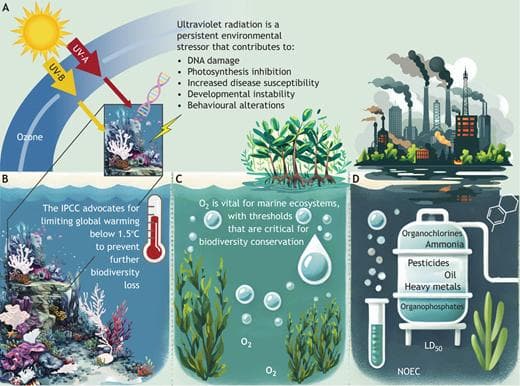
One major blind spot is ultraviolet (UV) radiation. While humans intuitively understand the danger of sunburn, UV radiation is rarely factored into climate models for fish. In shallow habitats with clear water and localized ozone depletion, marine animals are being heavily irradiated. This exposure damages DNA, inhibits photosynthesis in foundational corals, and drastically increases disease susceptibility. Crucially, UV interacts with temperature. A hot fish is stressed; a hot, sunburned fish is dead. Yet, "UV Safe Zones" remain virtually nonexistent on marine management maps.
Pollution metrics also suffer from a lack of physiological insight. Regulatory bodies frequently rely on "LD50" (Lethal Dose 50%), a metric denoting the concentration of a toxin required to kill half of a population. For conservation, accepting a 50% mortality rate is a catastrophic baseline. Physiology advocates for NOEC—No Observed Effect Concentration. The Deepwater Horizon oil spill perfectly illustrated this need. The spilled oil did not kill all exposed fish immediately, but physiological studies revealed it caused severe developmental abnormalities in their hearts. The fish survived the initial exposure but became the "walking dead," unable to swim fast enough to migrate or escape predators. If managers had only counted the bodies on day one, the true devastation would have been entirely overlooked.
Success Stories: When Physiology Meets Policy
Despite these challenges, the paper outlines powerful success stories where physiology directly informed policy, proving that integration is possible.
Protecting Pacific Salmon: Researchers studying Pacific Salmon focused on the fishes' "aerobic scope"—the spare energy required to migrate upriver, essentially the size of their physiological gas tank. Data revealed that when river temperatures rise too high, this aerobic scope collapses, making the journey biologically impossible. Today, fishery managers use real-time water temperature data to predict salmon survival. If it gets too hot, the fishery is closed, ensuring the fish are not subjected to the compounding stress of catch-and-release fishing during critical migrations.
Knowledge Co-production in Nunavut: In Nunavut, Canada, existing management zones for the Greenland Halibut were based on outdated spatial assumptions. Local Indigenous communities and Traditional Knowledge holders recognized that the fish were migrating differently than the maps suggested. Scientists utilized biotelemetry—tracking the physiological movements of the fish—which perfectly validated the Traditional Knowledge. By bringing this combined data to the Nunavut Wildlife Management Board, the boundary lines were successfully redrawn.
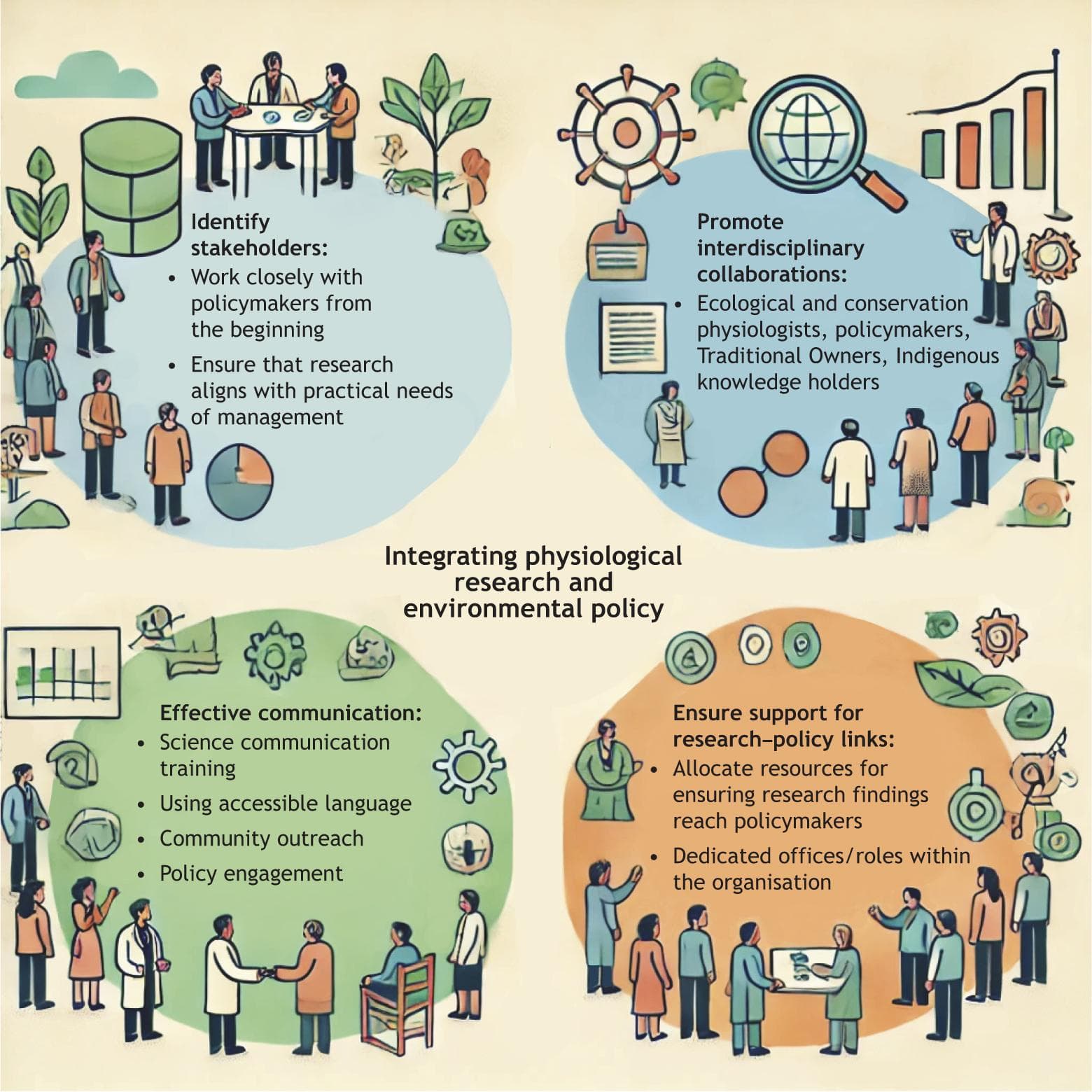
This is the power of "Knowledge Co-production." Rather than conducting research in a silo and handing a finished paper to lawmakers, co-production brings policymakers, scientists, and Traditional Custodians into the same room before an experiment begins, ensuring the research directly answers the needs of the community.
A Call to Action
Fixing the disconnect between the lab and the legislative assembly requires a systemic overhaul across three fronts:
- Researchers must step out of the laboratory and seek training in science communication. Data alone rarely changes minds; scientists must learn to translate complex graphs into compelling narratives that resonate with the public and politicians alike.
- Academic Institutions need to modernize their incentive structures. Universities must value and reward policy engagement, rather than exclusively prioritizing publishing. Young scientists should be supported—not penalized—for spending time collaborating with government agencies or building trust with Indigenous communities.
- Policymakers must proactively create space for evidence-based decision-making. Initiatives like the Universities Policy Engagement Network (UPEN) in the UK or "Science Meets Parliament" in Australia are vital models that need to be expanded globally.
The marine ecosystems we rely on are not abstract political debate topics; they are patients in an intensive care unit. The "athletes of the reef" are remarkably resilient, but they have hard physiological limits. Science now possesses the tools to accurately measure those limits. We just need the people in power to start reading the chart.